
On Wednesday, November 11, in Chiang Mai, I attended the opening of ETHChiangmai 2026 at 4Seas Nimman. Among the speakers was Vitalik Buterin, the co-founder of Ethereum.
A Giant in a Very Simple Setting
What struck me first was the contrast. Vitalik is one of the most influential people in tech, and he was speaking in a venue that, at first glance, seemed modest: a coworking and coliving space in the heart of the Nimman district, with open-plan offices and common areas. No big stage, no security, no elaborate staging.
4Seas isn’t like other coworking spaces. It’s the hub of a community centered around Ethereum: developers, founders, digital nomads, and the curious. Vitalik himself cites the place as an example, and this was his second visit this year. Seeing him there speaks volumes about the importance of this place and the community that brings it to life.
And what about him? Pretty normal, actually, even if he’s unconventional. He dresses simply, speaks well, and clearly has his head on his shoulders. I tried to exchange a few words with him at the end, but the timing wasn’t right: he had to leave. He told me so very kindly. It’s still impressive to have someone so important standing right in front of you, and who seems so down-to-earth.
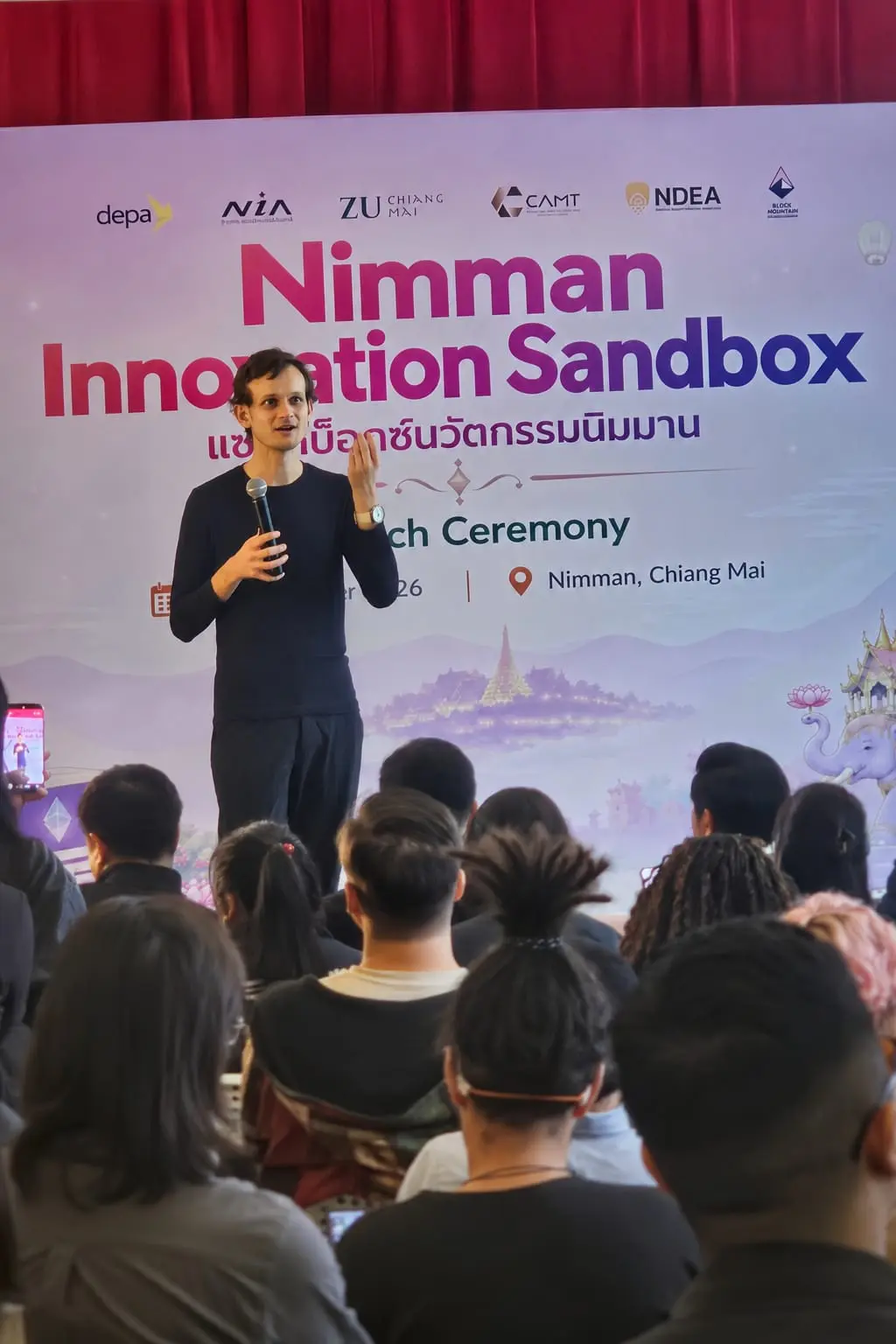 Vitalik Buterin at the microphone at 4Seas Nimman.
What He Said, in Plain Language
The talk lasted about a quarter of an hour and was in English.
1. AI has turned everything upside down. According to Vitalik, AI has dramatically changed productivity in certain fields. In programming, tasks that used to take him three months can often be completed in a single day. It’s also changing cybersecurity in both directions: hacking is becoming easier, but building much more secure systems is too.
2. Ethereum is refocusing. He went back to the origins. Bitcoin’s very first block, from January 2009, contains a newspaper headline about the bank bailout: at the time, the big issue was trust in the financial system. Today, the Ethereum Foundation has made a clear choice. Its goal is not to make finance “1% more efficient,” even though that’s enormous on a global scale. Its goal is decentralization: open applications, accessible to everyone, without having to ask anyone for permission.
3. And it’s taking a broader view. At the same time, Ethereum no longer sees itself as the center of the world. What matters are the values behind it: more secure operating systems, tools to protect privacy, a more open biotech sector, and the physical world. As he put it: “Atoms, not just bits.”
4. Diversity, but productive. He praised 4Seas, which brings together people of different nationalities, languages, and professions: blockchain, longevity, biohacking, literature, and philosophy. In his view, diversity is becoming rare because everyone follows the same topics and watches the same movies. But simply putting different people in a room isn’t enough: without a framework, it ends in an argument. The exchange must be productive.
5. Accelerate, yes, but toward what? This is a striking idea. For millennia, accelerating technology was the best course of action. But today, everything is moving so fast that people’s lives are turned upside down several times a year. So the real question is no longer “should we accelerate?” but “toward what are we accelerating?” His answer: toward technology that everyone can understand, modify, and share, with security as the top priority.
Not Just Vitalik
ETHChiangmai isn’t just a one-day conference. It’s an entire season, from November 11 through the end of the year: coliving, an “unconference” that runs throughout, two nomad markets (November 14–15, an event I was lucky enough to participate in as an exhibitor, and December 25–26, when I’ll be back to present a new product), a month dedicated to longevity starting November 30, followed by a hackathon and talks in late December. The theme of this edition: “The Non-Negotiables of Ethereum”: the things Ethereum must not compromise on (censorship resistance, privacy, security).
The opening afternoon featured a series of short presentations. Many other speakers took the stage, covering a wide variety of topics: developer communities, AI, community life, and other blockchain events in Asia. All of this took place in front of a very diverse audience, with a musician playing in the background.
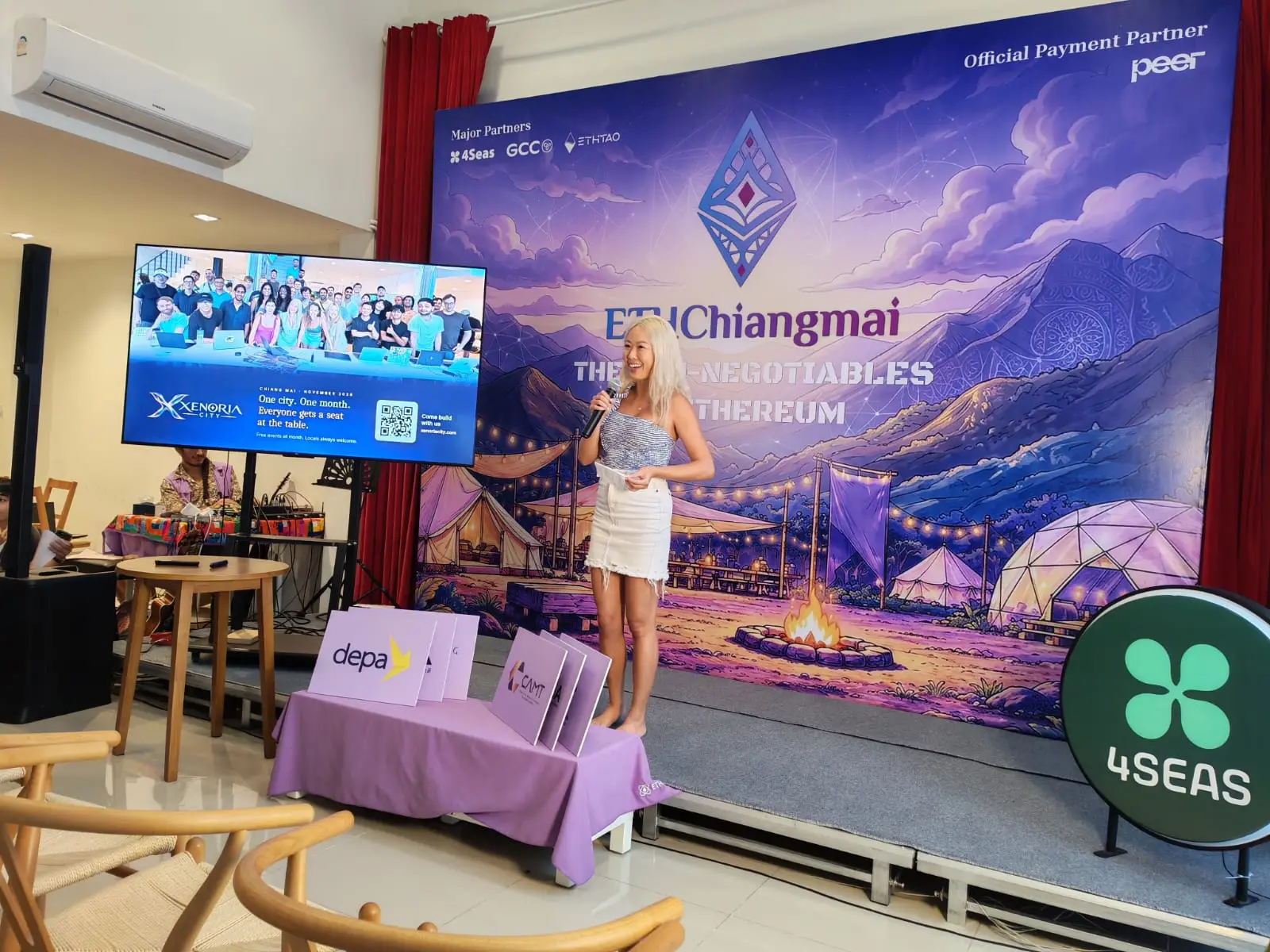
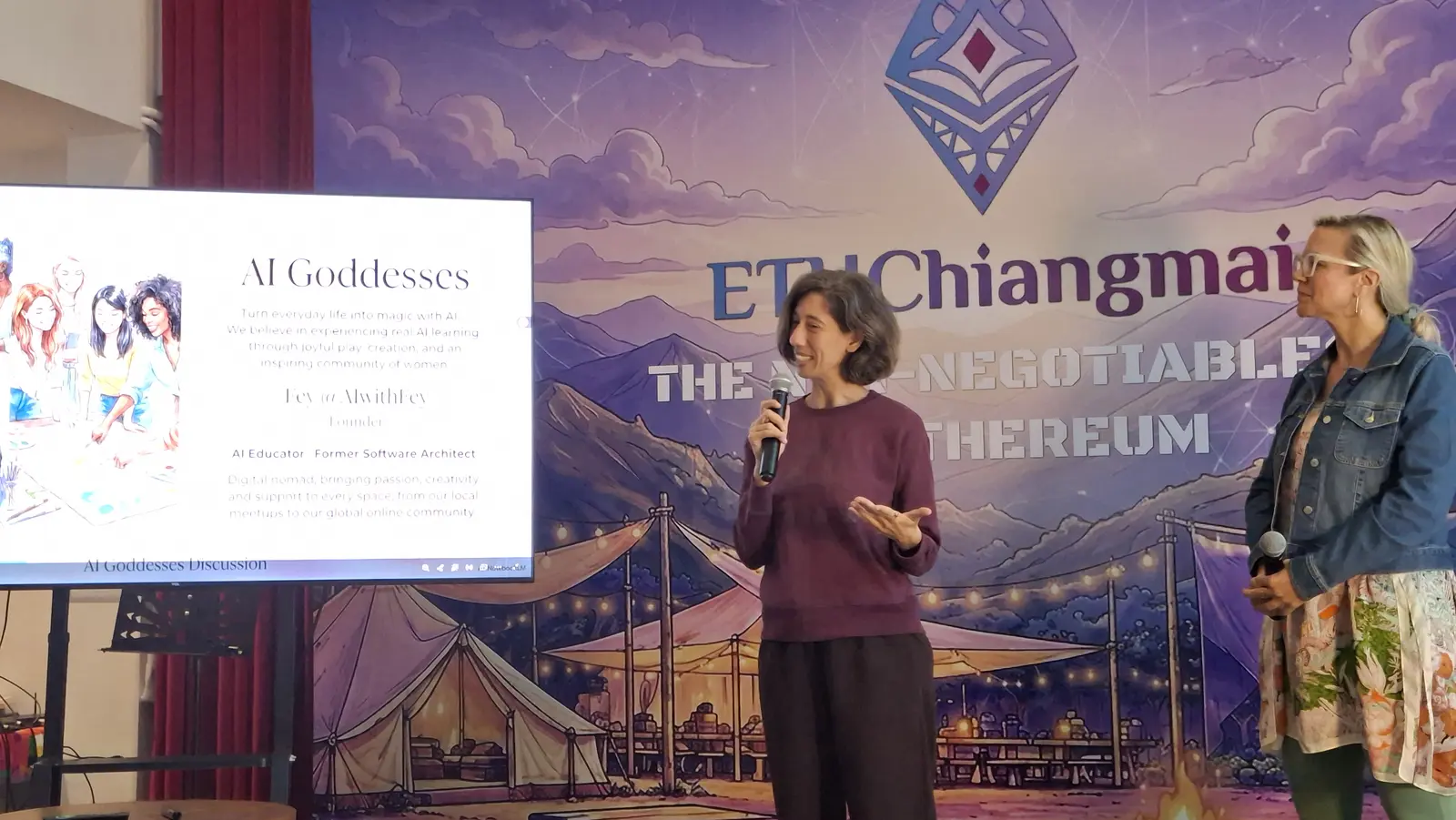 More speakers, more topics: the opening afternoon was packed with content.
For the season, the organizers have announced about twenty speakers, including Michel Bauwens (founder of the P2P Foundation), Clément Lesaege (co-founder of Kleros), and 0xSachin (co-founder of Peer, the event’s payment partner). Not all of them spoke on Wednesday; the lineup spans the two-month period. Partners include 4Seas, GCC, and ETH TAO; Peer for payments; Kleros, NEAR, and Devfolio; and a whole host of Ethereum communities from Asia: ETH PH, ETH Tokyo, ETH Singapore, ETHKL, ETH Shenzhen, ETH Hangzhou…
Same Day: Chiang Mai Launches Its Innovation “Sandbox”
That same afternoon, just before that, I attended another ceremony: the launch of the Nimman Innovation Sandbox. Behind this name is depa, Thailand’s digital economy promotion agency, along with Zu Chiangmai (another name for 4Seas Nimman), and several partners: the national innovation agency (NIA), an association of digital businesses from the North (NDEA), Block Mountain, and a faculty at Chiang Mai University (CAMT).
The idea: to turn the Nimman neighborhood into a zone where developers, researchers, and founders, Thai and foreign alike, can test new technologies in real-world settings.
4Seas finds itself at the center of this zone, and I’m fortunate to be able to play a modest role in this development and benefit from it.
Three key areas to start with: AI, longevity (health and data), and smart cities, with Nimman serving as the testing ground. Participants have access to existing support programs: startup funding, training, and Thailand’s Smart Visa for qualified professionals.
Thailand is clearly seeking to attract tech talent. Chiang Mai is already one of the top destinations for digital nomads. Forbes ranked it this year among the world’s top eight cities for them. And when it comes to crypto, the country regulates rather than bans: its securities regulator has just authorized crypto ETFs, subject to certain conditions. Seeing an Ethereum co-founder and a government agency in the same room on the same day speaks volumes.
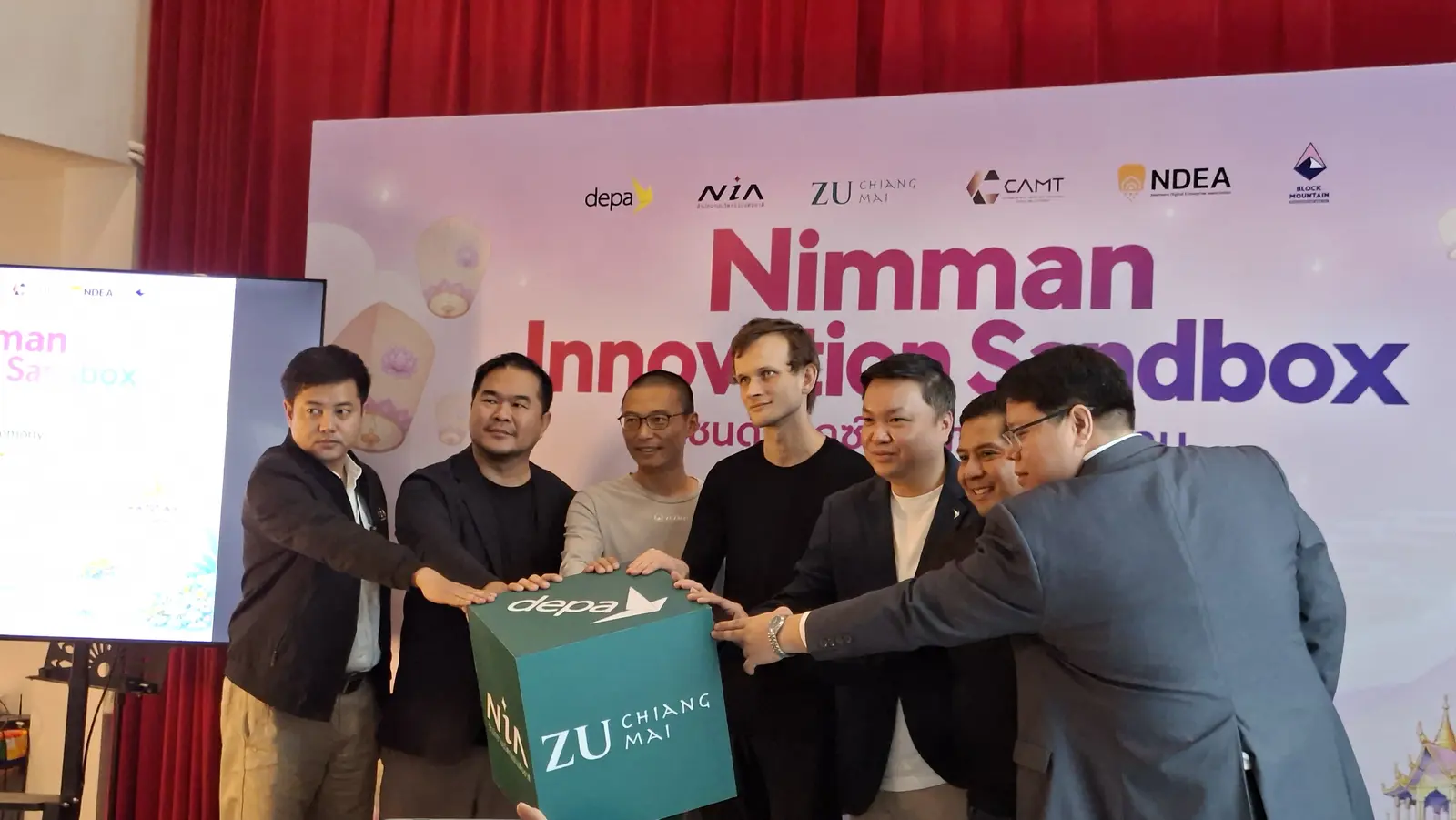 The launch of the Nimman Innovation Sandbox, with Vitalik Buterin in the center.
My Takeaways
I find Vitalik’s question, “What are we accelerating toward?”, useful far beyond the realm of crypto. I work with AI agents every day, and this is exactly the right lens through which to view things: Do I understand what the tool is doing? Can I modify it? Do I remain in control of my data? When the answer is no, it’s worth taking a moment to pause and reflect.
In fact, to explore this topic further, I read the article where Vitalik describes how he uses AI himself: My self-sovereign / local / private / secure LLM setup (April 2026, in English). I was very interested in his approach to using local AI agents. The models run on his own laptop, not on a provider’s servers. Most of the time, his agents operate in a “sandbox” that only has access to the folder where the agent was launched. An agent can read his messages but cannot write to anyone else without his confirmation, and he recommends the same rule for an Ethereum wallet. His idea: humans and AI make mistakes in different ways, so for a risky action, both must agree. He also remains realistic: for complex code, a local model isn’t sufficient yet, so he turns to a more powerful, remote model, revealing as little as possible about himself.
And then, beyond the content, there’s the image: one of tech’s leading figures, in a neighborhood coworking space, taking the mic just like any other speaker… It was a great experience.
It’s part of the life of a digital nomad. You sometimes meet amazing people. I’ll share more stories from some of the events I’ve attended this year. Southeast Asia is an incredible region when you’re motivated and want to build something.
Cover image: ETHChiangmai 2026.