
On Wednesday, November 18, I was at the Bitcoin Learning Center in Chiang Mai. That evening, the place was hosting the speakers of Freedom to Transact, an event taking place the next day. I was there a bit as a plus-one: my girlfriend, Géraldine, is one of the speakers, representing the Philippines. So I got to chat with people, and I took the opportunity to bring out the microphone.
What Is Freedom to Transact?
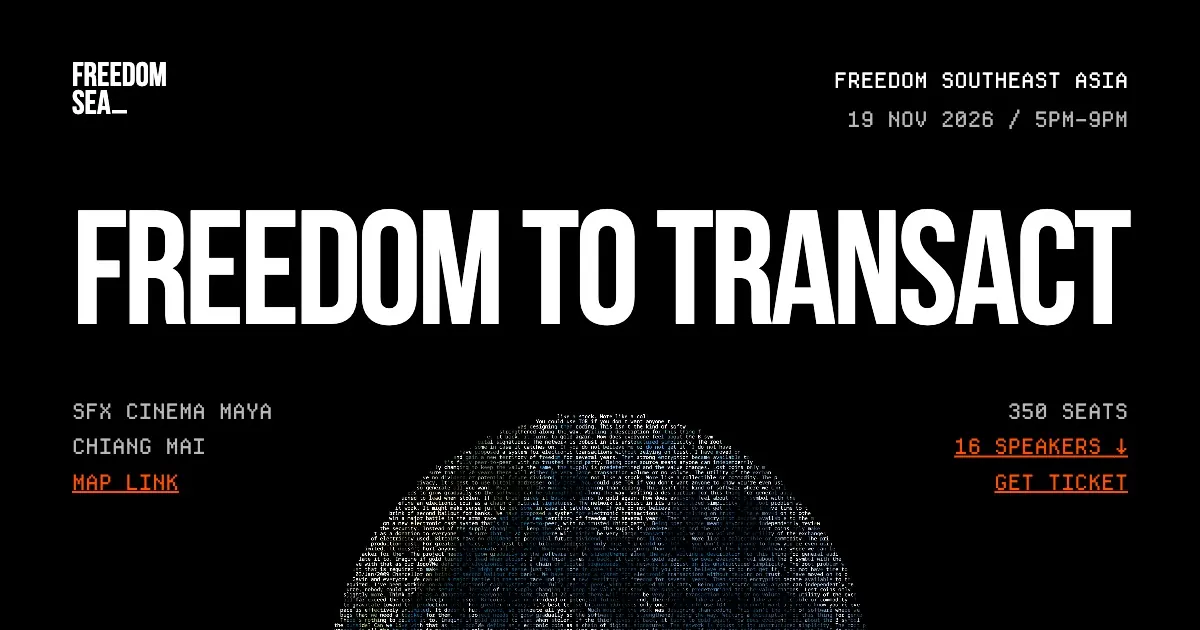
Freedom Southeast Asia 2026, subtitled “Freedom to Transact,” is an evening of short talks, about ten minutes each, TED-style. The theme: freedom, sovereignty, money, technology, human rights, and the reality of each country. It takes place on Thursday, November 19, from 5 to 9 p.m., in a 350-seat theater at the SFX MAYA cinema in Chiang Mai. Tickets are on Satlantis.
As you can see from the list of speakers, almost all of Southeast Asia is there: Thailand, Malaysia, Singapore, Indonesia, Vietnam, Laos, Myanmar, the Philippines, plus a few guests from Japan, Europe and the United States, including the Human Rights Foundation. Behind the event are Bitcoin Chiang Mai and its venue, the Bitcoin Learning Center.
Jason Chew, Ten Years of Explaining Bitcoin
 Jason Chew during the interview, at the Bitcoin Learning Center.
Jason is from Malaysia. For the past two years, he has been running BTC Education Hub, a Bitcoin education company in Kuala Lumpur that mainly trains business leaders, entrepreneurs and executives. But he has been teaching Bitcoin for ten years, and he is well known in the Bitcoin Malaysia community. His courses don’t teach people to trade. They explain why Bitcoin exists, where it comes from, and why, in his words, it is “such an amazing invention, a gift from Satoshi Nakamoto to humanity.”
My first question was simple: “What is your feeling now about Bitcoin?” His answer might come as a surprise.
“Not Great. Not Because of the Price”
“Not great,” he told me. “Not because of the price, but because of where we might be going.” For Jason, Bitcoin is losing. Not because it’s broken, but because too many people are paying attention to the wrong thing.
He brought up this year’s hacks. In late July, a flaw in the software of Coldcard hardware wallets allowed attackers to drain more than 5,000 addresses, for over $100 million: a hard blow, because that is exactly the kind of tool people recommend for holding your own bitcoin. Then came the exchanges: Bitget in September, nearly $390 million, and Binance in late October, about $6.3 billion, a record. Whether it’s self-custody or an exchange, he says, the sentiment right now is: “Why am I even doing this?”
Above all, he told me about his clients. Last year, he helped about ten people become “full Bitcoiners.” He was proud of it. Since then, six of them have sold. And the reason is always the same: “I don’t feel safe anymore.”
Yet these aren’t gamblers or speculators. They are intelligent, skeptical people who came to understand. That is precisely what worries him.
Money Is Stored Effort
At the heart of his message is a definition of money that I find very telling. “In the last ten years I realized that money is actually a tool to store effort,” he says. A salary is proof of the work you delivered to your employer. A client who pays you is proof that you brought them some value. And we want to carry that effort across space and time.
Except it doesn’t work well. Across space: when a Malaysian comes to Thailand, their money goes through a money changer, and “there is always a cut.” Across time, it’s worse. Jason takes the example of old American movies from the 1950s, with the milkshake and the burger for fifty cents. Today, it’s twenty dollars. “Has the milkshake changed? Has the burger changed?” And a hundred thousand dollars in cash put under your bed twenty years ago would have lost easily 50% of its purchasing power, “if not more.” I told him that I think it’s much more, especially if you look at food rather than official inflation.
His conclusion: if money held its value, we wouldn’t have to keep chasing investments. “For the last thirty years we’ve been obsessed with the word investment,” he says, “because we have no choice.” And when everyone stores their savings in property, housing prices soar. Our parents could buy a house for a hundred thousand dollars forty years ago. Today, you need to work at least ten years to earn one. I added that it’s even worse than inflation: our work brings us less value than it used to, and wealth is concentrating in fewer and fewer hands.
Why Fiat Is So Strong
Jason has one line that sums it all up: “I think Bitcoin is losing because fiat is so strong now.” Fiat is government-issued money, the kind that can be printed.
He started with a game. Remember Who Wants to Be a Millionaire?, Forrest Gump, Slumdog Millionaire? “Once upon a time, who wants to be a millionaire used to mean something.” Then came the song “I wanna be a billionaire.” And now, “we’re in the world of trillions. It feels numb.” For him, that is the point of Bitcoin: a system that is globally verifiable, “where numbers can finally make sense again in a world where numbers don’t make sense.”
The US dollar remains the reference. “People have an imagination of what one US dollar of value can give,” he says. A South Korean won, on the other hand, forces you into a mental calculation: think of the prize money in Squid Game. The dollar is the world’s unit of account. I pointed out that it’s a good reference but a bad way to measure the value of things, since the ruler itself keeps shrinking. His answer: “It’s the current state of things.”
Where does this strength come from? From two money-creation machines, according to him. First, central banks, which print money in times of crisis, as in 2008, when a giant insurance company that had bet on the housing bubble was bailed out with taxpayers’ money instead of being allowed to fail. Jason compares it to a child who does something wrong and whose daddy fixes everything: “they will never learn.” Second, fractional reserve lending, which lets commercial banks lend far more than they hold in deposits. For him, this combination financed the spectacular growth of the last thirty years. He remembers visiting Beijing in 1998, when people were still riding bicycles. Today, entire cities have sprung up across China. Every coffee chain, every trendy toy: “Did somebody use their hard-earned savings? No, it’s finance.”
We Need Better Bitcoin Stories
His answer: evolve Bitcoin education. He describes his own journey. At first, he explained SHA-256 and how the blockchain works, and people wondered how it related to them. Then, like “99%” of what you find on the subject, it’s about getting rich: buy low, sell high, DCA. He wants to move to the next step: understanding what money is, and why Bitcoin solves its problem, because “money today cannot hold value.”
Above all, he wants better Bitcoin stories. For example, a bank backed by real, verifiable bitcoin. “It’s not the word bank that is a dirty word. The dirty word is fractional reserve lending.” With $100 billion in bitcoin, such a bank couldn’t lend a trillion, maybe fifty billion, so it would have to choose carefully who it lends to, “because I cannot afford bad loans.” Or communities that, beyond donations, build up a bitcoin treasury to create things. He actually put the question to Jimmy, at the Bitcoin Learning Center, which does a lot of work with marginalized communities: does it stop at donations, or can these communities build something with a treasury of their own?
He ended with a story I find very honest. At his very first Bitcoin gathering, in a coffee shop that accepted bitcoin, he had bitcoin on his phone… and he paid in cash. He thought his bitcoin would be worth a lot more one day. “That is the wrong mindset,” he says today. When someone is willing to exchange their work for bitcoin, you should support them. He quotes Jack Dorsey: if Bitcoin is just a digital gold rock, it will fail. Money needs to move. I added that if a single player, BlackRock or anyone else, owned everything, it would no longer have any value. For Jason, even if there were only one million bitcoin left for everyday people, “we can still function”: denominations adapt, just as the yen and the dollar work on different scales.
Tomorrow on Stage, and Soon on Video
Jason’s talk tomorrow is titled “I taught Bitcoin wrong for eight years.” After this conversation, I understand better what he means. And I can’t wait to hear the other speakers, Géraldine included.
The full interview will be released on video on my upcoming YouTube channel and on my social networks. I’ll post the link here as soon as it’s online.
And you: is your bitcoin tucked away, or do you keep it moving?